

All-Season Tyres
All-season tyres let you drive on one set all year, but they are a compromise between summer and winter tyres. In Latvia they may be used during the mandatory winter period, from 1 December to 1 March, only if they carry the 3PMSF symbol – M+S alone is not enough. Read the guide


 M+S
M+S
M+S
M+S
M+S
M+S
 M+S
M+S
 M+S
M+S
M+S
M+S
 M+S
M+S
M+S
M+S
M+S
M+S
M+S
M+S
M+S
M+S
M+S
M+S
M+S
M+S
M+S
M+S
M+S
M+S
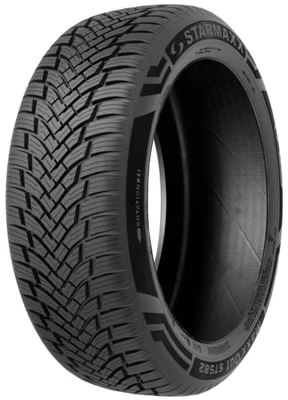 M+S
M+S
M+S
M+S
M+S
M+S
M+S
M+S
M+S
M+S
M+S
M+S
M+S
M+S
M+S
M+S
M+S
M+S
Who all-season tyres suit
- drivers with low annual mileage who mostly use cleared city streets;
- those who can wait out the worst weather in winter and rarely drive on rural roads;
- anyone who would rather not change tyres twice a year and store a second set.
A Latvian winter, with frequent thaws and refreezing and with ice and snow on country roads, is a tough test for an all-season tyre. If you often drive outside town or early in the morning, dedicated winter tyres are the safer choice.
What Latvian rules require
From 1 December to 1 March, cars and vans up to 3.5 t must run on winter tyres marked with the mountain-and-snowflake symbol (3PMSF). An all-season tyre with 3PMSF meets this requirement; one marked only M+S does not. In this period the tread must also be at least 4 mm, and that applies to all-season tyres used as winter tyres too. A worn all-season tyre can therefore stop being compliant in winter sooner than in summer, when the minimum is 1.6 mm.
What you give up
- Summer: longer braking distances and faster wear in the heat than summer tyres.
- Winter: weaker than winter tyres on ice and in deep snow.
- Convenience: one set means fewer changes and nothing to store, but it wears all year round.
How to choose and when to replace
- 3PMSF symbol on the sidewall – without it, an all-season tyre cannot be used in Latvia during the mandatory winter period.
- Wet grip on the EU label – an all-season tyre spends much of the year on wet asphalt, so this class matters a lot.
- Load index and speed rating – no lower than the car maker specifies.
- Tread before winter – check it in autumn: if it will be below 4 mm by December, replace the set before the mandatory period starts.
Our article on the 3PMSF marking explains how it differs from M+S.