
What is a homologation code?
OE (Original Equipment) marking on a tyre indicates that this tyre was specifically developed in cooperation with a car manufacturer. The homologation process can take up to 3 years and involves numerous tests to ensure the tyre meets the exact requirements of a particular vehicle model.
Why choose homologated tyres?
Homologated tyres offer several advantages:
- Optimal performance – designed for your specific vehicle's weight distribution and suspension
- Reduced noise – tuned to minimize cabin noise for your car model
- Better fuel efficiency – optimized rolling resistance
- Improved handling – manufacturers like AMG focus on dry handling and lateral aquaplaning, while BMW's M Division prioritizes lap times
- Warranty compliance – some manufacturers require OE tyres for warranty claims
Where to find the homologation code?
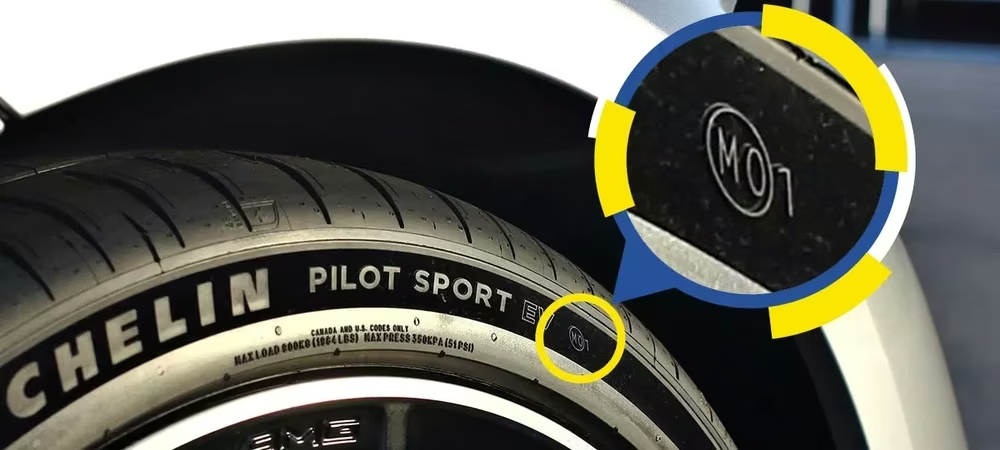
The homologation code is embossed on the tyre sidewall, usually near the tyre size marking or brand name. It's a short code of 1-4 characters.
Homologation codes by manufacturer
Click on your car manufacturer to view available homologated tyres in our catalog:
| Manufacturer | Codes | Description |
|---|---|---|
| BMW / Mini → | *, I* | * standard, I* electric (iX, i4) |
| Mercedes-Benz → | MO, MO1, MO1B, MOE, MO-S, MO-V | MO standard, MO1 AMG, MOE run-flat, MO-S S-Class, MO-V V-Class |
| Audi → | AO, AO1, AO2, R0, RO1 | AO standard, AO1/AO2 Quattro, R0 R8, RO1 RS models |
| Porsche → | N0, N1, NC0, ND0, NE0, NF0 | N0/N1 generations, NC0 Cayenne, ND0 Panamera, NE0 Macan, NF0 Taycan |
| Volkswagen → | + | Volkswagen approved |
| Volvo → | VOL | Volvo approved |
| Tesla → | T0 | Low noise, optimized for electric vehicles |
| Jaguar → | J | F-Type, F-Pace, E-Pace |
| Land Rover → | LR | Land Rover approved |
| Maserati → | MGT | Maserati GranTurismo |
| Alfa Romeo → | AR | Alfa Romeo approved |
| Hyundai / Genesis → | HN, GOE, G1 | HN Hyundai, GOE/G1 Genesis |
Do I have to use homologated tyres?
Homologated tyres are recommended but not mandatory. You can use any tyre that meets the size and load requirements for your vehicle. However:
- Some manufacturers may require OE tyres for warranty claims
- OE tyres are specifically tuned for your vehicle's characteristics
- Non-OE tyres of the same size will work perfectly fine for everyday driving
- If you drive an Audi, BMW, Jaguar, Land Rover, Maserati, Mercedes-Benz, Mini, Porsche or Tesla – fitting non-OE tyres may compromise optimal performance settings
Frequently Asked Questions
Can I mix homologated and non-homologated tyres?
It's best to have all four tyres of the same type. If mixing is necessary, keep the same type on each axle.
Are homologated tyres more expensive?
Yes, typically 10-20% more expensive than non-OE versions of the same tyre model.
Do homologated tyres last longer?
Not necessarily – they're optimized for performance, not longevity. Wear depends on driving style and conditions.
What do the generation numbers mean (N0, N1, etc.)?
For Porsche, the number indicates how many times the tyre specification has been updated. N0 is the first approval, N1 is the second generation with improvements, and so on.